
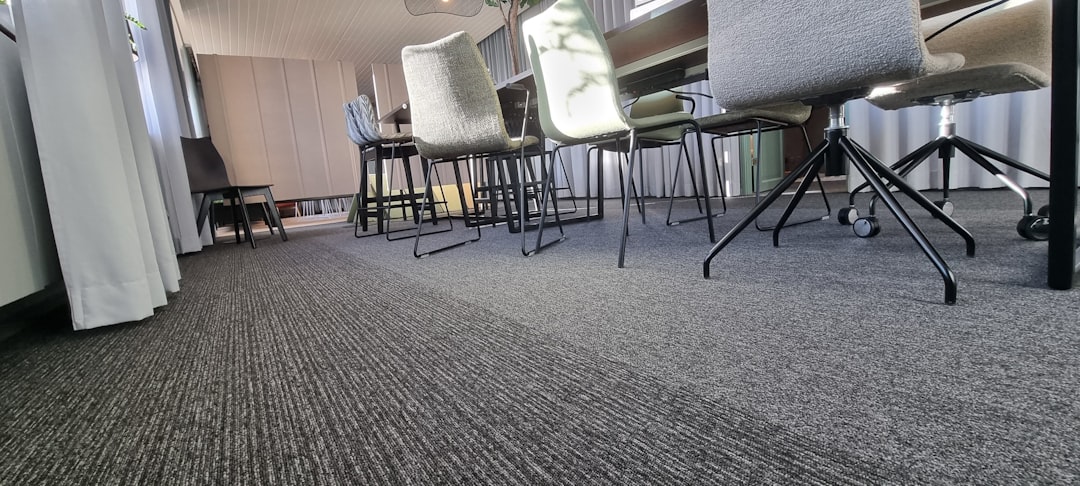
A new office or retail fit-out moves fast. Contractors are on site, the handover date is fixed, and carpet is often treated as an afterthought: something to order once the partitions are up. That approach is how businesses end up with a pile that looks tired within eighteen months, a colour that shows every scuff from the lobby to the meeting room, or tiles that lift at the edges because the adhesive was chosen for a raised floor, not a concrete slab.
The carpet you specify at fit-out is a five-to-ten-year decision. Get it right and the floor practically looks after itself. Get it wrong and you are looking at premature replacement, constant spot-cleaning, and a space that never quite looks professional.
Why this matters: Commercial carpet selection affects not just appearance but long-term maintenance costs, indoor air quality and the total fit-out budget, and the decisions are made once, early, under time pressure.
Highlights
- Pile height, fibre type and tile format should be matched to your actual foot-traffic pattern, not chosen from a catalogue.
- Carpet tiles give facility managers the ability to replace individual damaged squares; broadloom costs less upfront but is harder to patch.
- Concrete subfloors in Singapore commercial buildings require the right adhesive and moisture assessment before any installation begins.
- Poor installation voids most manufacturer warranties and accelerates wear at seams and edges.
- Big Red supplies and installs commercial carpet island-wide, from a single office floor to a multi-level fit-out.
The decisions that matter before you order a single roll
Foot traffic and pile height
Pile height determines how long a carpet holds its appearance under load. In a high-traffic commercial environment, a retail entrance, an open-plan office corridor, a hotel lobby, a low, dense loop pile (typically 2.5 mm to 4 mm) outperforms a higher cut pile on every measure: it resists crushing, releases soil more easily, and recovers between cleans. Cut pile is fine in a boardroom or a private office that sees perhaps a dozen footfalls a day. Put it in a corridor that takes three hundred, and it shows.
Fibre matters too. Nylon is the standard choice for commercial work: it handles heavy foot traffic, resists abrasion, and responds well to hot-water extraction cleaning. Polypropylene costs less but tends to re-soil faster and does not recover from crushing as well. Wool is an option for premium spaces, but it requires a more careful cleaning regime and carries a higher upfront cost.
Carpet tiles vs broadloom
This is the single most consequential format decision, and it is worth thinking through clearly.
|
Format |
Upfront cost |
Patching damaged areas |
Best for |
|---|---|---|---|
|
Carpet tiles (modular) |
Higher per sqm |
Replace individual tiles |
Open-plan offices, retail, areas with cable access |
|
Broadloom (wall-to-wall) |
Lower per sqm |
Difficult; requires full section replacement |
Private offices, hospitality, smaller rooms |
|
Carpet tile with adhesive |
Higher install cost |
Straightforward |
Concrete slabs, heavy traffic, permanent layouts |
|
Loose-lay carpet tile |
Lower install cost |
Very easy |
Raised floors, temporary fit-outs, easy reconfiguration |
For most Singapore commercial fit-outs, carpet tiles are the practical choice. They sit flat on a concrete slab, they accommodate underfloor cable trays, and when one area takes a heavy stain or a trolley tears a corner, you replace those squares rather than the whole floor. The total lifetime cost is usually lower, even if the day-one price is not.
Broadloom makes more sense in hospitality settings, where a seamless look matters, or in smaller private offices where the risk of spot damage is low.
Subfloor preparation and installation: where most projects go wrong
Concrete slabs and moisture
Most Singapore commercial buildings hand over a bare concrete slab. Before any carpet goes down, that slab needs to be assessed for moisture content and levelness. Concrete in a humid tropical climate can hold residual moisture for longer than builders expect, and laying carpet over a damp slab creates the conditions for mould, adhesive failure, and that musty odour that never quite leaves a new office. This is not a theoretical risk, our installation teams encounter it regularly on fit-outs across the island.
The CRI 104 commercial installation standard sets out the industry's accepted principles for subfloor preparation, adhesive selection and installation practice. It exists because getting these steps wrong invalidates most manufacturer warranties and causes premature failure at seams and edges.
For adhesive-down tiles on concrete, the adhesive specification should match the slab's porosity and the expected foot traffic. A pressure-sensitive adhesive that works on a raised access floor will not perform the same way on a poured slab.
Underlay: when you need it and when you do not
Commercial carpet tiles are usually installed direct-stick, without underlay, because underlay introduces movement that causes tile edges to lift. Broadloom on a concrete slab, however, benefits from a commercial-grade underlay: it adds underfoot comfort, provides a degree of acoustic dampening (useful in open-plan offices where sound carries), and extends the carpet's usable life by reducing pile compression.
Do not use a domestic underlay in a commercial setting. Domestic foams compress quickly under sustained load, and once compressed they create uneven wear patterns across the carpet above them.
Seam placement and pattern matching
Seams are the point where most installations show their quality, or lack of it. In a busy corridor, a seam placed across the main traffic line will show within months. Seams should run parallel to the primary traffic direction and, where possible, be kept out of high-wear zones entirely. For patterned carpets, matching repeat across seams takes time and wastes some material, but a mismatched pattern in a client-facing space looks like a mistake that cannot be fixed.
The hidden cost of a poor specification
Facility managers who have been through a premature carpet replacement will tell you the same thing: the carpet itself was the smallest part of the cost. The real expense is the disruption, moving furniture, closing sections of the office, bringing in contractors during business hours, disposing of the old carpet. In a retail setting, that disruption directly affects revenue.
A carpet specified correctly for its use, installed to standard, and maintained on a regular schedule should last eight to twelve years in most commercial settings. The same carpet under-specified for the traffic it carries may need replacement in three to four. The difference in lifetime cost is significant, and it starts with the decisions made at fit-out.
Our commercial carpet supply and installation service covers the full process: specifying the right product for your traffic pattern, assessing the subfloor, and installing to CRI commercial standards. Because we also run professional carpet cleaning across Singapore, we know from experience which specifications hold up under sustained use and which ones do not, and we build that into the advice we give at the beginning of a project.
For ongoing care after installation, our commercial carpet cleaning service keeps the investment looking its best and extends the time between replacements. We also cover carpet stain removal when something gets through the daily maintenance.
If you are also specifying hard flooring for reception areas or common corridors, our marble and parquet floor care service covers both installation advice and ongoing maintenance for those surfaces.
When to bring in a specialist and when you can manage it yourself
A facilities manager with experience in fit-out can absolutely manage the specification process, brief a supplier, and oversee an installation. The decisions are not complicated once you understand the variables.
What goes wrong is usually one of three things: the subfloor assessment is skipped because the programme is tight, the adhesive is not matched to the slab condition, or the seams are placed without regard for traffic direction. These are installation errors, not specification errors, and they are hard to fix after the fact.
Bringing in a supplier who also handles installation, and who can assess the subfloor before ordering product, removes the gap between specification and execution. It also means a single point of accountability if something goes wrong.
Frequently asked questions
How do I know whether to specify carpet tiles or broadloom for my office?
For most open-plan Singapore offices, carpet tiles are the better choice: they handle subfloor access for cables, allow individual damaged squares to be replaced, and sit flat on a concrete slab without underlay. Broadloom suits smaller private offices or hospitality settings where a seamless look is the priority and the risk of spot damage is lower.
What subfloor preparation is needed before commercial carpet installation on a concrete slab?
The slab needs to be checked for moisture content, levelness and cleanliness before any carpet goes down. In Singapore's humid climate, residual concrete moisture is common and causes adhesive failure and mould if not addressed. The CRI 104 commercial standard sets out the accepted preparation steps, skipping them typically voids the carpet manufacturer's warranty.
How long should a commercial carpet last in a Singapore office or retail space?
A carpet correctly specified for its traffic load and installed to commercial standards typically lasts eight to twelve years with regular maintenance. A carpet under-specified for its environment, wrong pile height, wrong fibre, wrong adhesive, can need replacement in three to four years. The specification decision made at fit-out is the single biggest factor in long-term durability.
Does Big Red supply and install carpet as well as clean it?
Yes. Our carpet supply and installation service covers commercial fit-outs island-wide, from a single floor to a multi-level project. Because our teams also carry out ongoing maintenance cleans, we specify products we know perform well under sustained use and regular hot-water extraction cleaning.
What ongoing maintenance does a commercial carpet need after installation?
For most commercial settings, a professional deep clean using hot-water extraction once or twice a year keeps the carpet in good condition, removes embedded soil and allergens, and extends its useful life. High-traffic areas benefit from more frequent attention. Daily vacuuming by the building's cleaning team handles surface debris between professional cleans.
Ready to specify the right carpet for your fit-out?
Big Red's commercial team covers supply, installation and ongoing maintenance island-wide. Get a free quote, call us on 6241 9443, WhatsApp 9222 9222, or email [email protected].